
And the Technology Helping Scientists Study Sleep in the Wild
Sleep is a fundamental biological process shared by nearly all animals. Yet in extreme environments, sleep must adapt in remarkable ways to ensure survival.
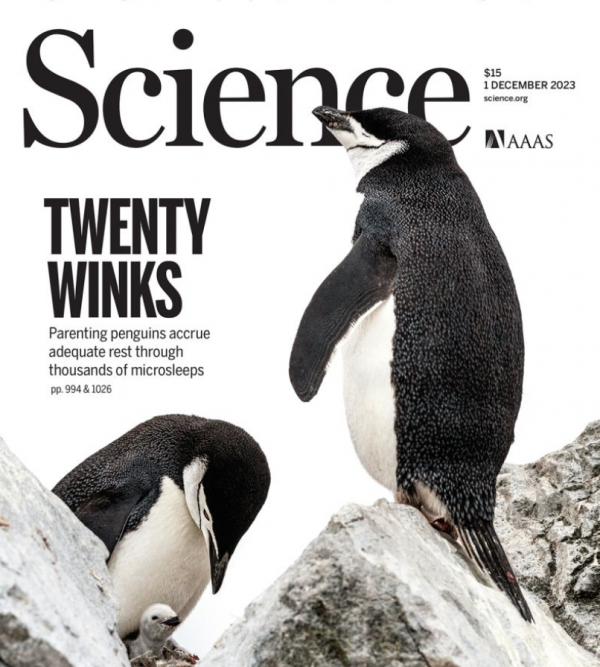
A groundbreaking study published in Science (Volume 382, Issue 6674, December 2023) revealed one of the most unusual sleep strategies ever documented in the animal kingdom: Antarctic chinstrap penguins sleep thousands of times per day—each time lasting only a few seconds.
This discovery, led by neuroscientist Dr. Paul-Antoine Libourel, provides new insight into how sleep functions in the brain. The research was conducted in Antarctica and relied on advanced physiological monitoring technology, including custom biologging loggers based on Manitty’s Phynitty system.
The study highlights not only the extraordinary adaptability of sleep in nature, but also the critical role that biologging technology and wildlife telemetry loggers play in modern neuroscience research.
The Mystery of Penguin Microsleep
In most animals, sleep occurs in relatively long and consolidated periods. Humans typically sleep several hours continuously, allowing the brain to perform essential restorative functions.
But chinstrap penguins nesting in Antarctica face a difficult challenge.
During the breeding season, penguins must remain near their nests almost constantly to protect eggs from predators such as brown skuas, while also defending territory against neighboring birds in dense colonies.
Falling into deep sleep for extended periods could expose their eggs to danger.
Instead, researchers discovered that penguins have evolved an extraordinary strategy: microsleep.
Using physiological monitoring techniques, scientists found that chinstrap penguins:
fall asleep more than 10,000 times per day
each sleep episode lasts approximately 4 seconds
these short naps accumulate to over 11 hours of total sleep daily
Rather than sleeping in long uninterrupted blocks, penguins accumulate sleep through thousands of micro-episodes of slow-wave sleep, allowing them to remain vigilant while still meeting the brain’s need for rest.
This is one of the most fragmented sleep patterns ever recorded in any animal species.
Measuring Sleep in the Wild
Studying sleep in animals under natural conditions presents major technical challenges.
Traditional laboratory experiments allow researchers to monitor brain activity under controlled conditions. However, animals in the wild behave very differently from those in captivity, especially when exposed to environmental stressors such as predators, weather, and social interactions.
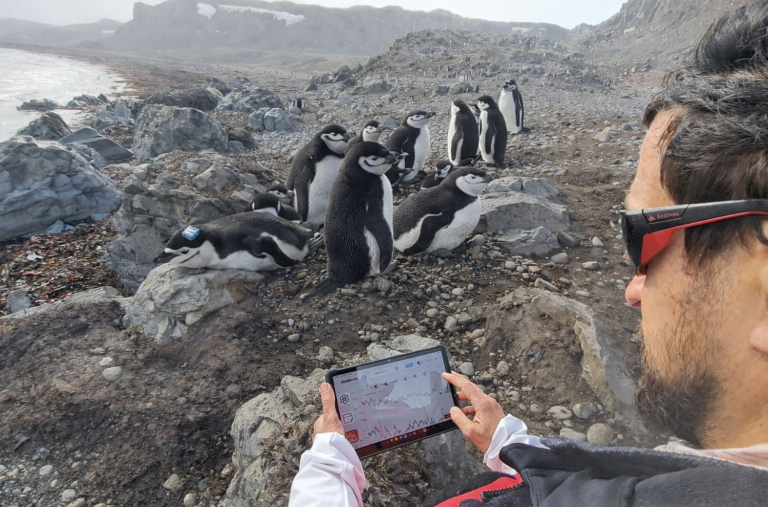
To understand penguin sleep in its natural habitat, researchers conducted field experiments on King George Island in Antarctica.
The team monitored multiple physiological and behavioral signals, including:
brain electrical activity (EEG)
muscle activity
body movement and posture
behavioral observations in nesting colonies
These measurements allowed scientists to detect extremely short sleep episodes lasting only seconds.
Capturing this level of physiological detail outside a laboratory requires advanced sensing technology capable of operating in harsh environments.
Technology Enabling Field Neuroscience
The study relied on custom biologging loggers based on Manitty’s Phynitty solution, designed to record physiological and behavioral signals from freely moving animals.
Field neuroscience research requires devices that are:
lightweight and minimally invasive
capable of recording high-resolution neural signals
robust enough for extreme environmental conditions
energy-efficient for long-duration recording
The Phynitty logger platform was engineered to meet these challenges.
As an advanced animal EEG logger and wildlife telemetry system, Phynitty allows researchers to capture neural and behavioral data in real-world environments without significantly affecting animal behavior.
Such technologies are increasingly important in modern sleep neuroscience technology, enabling scientists to study brain activity in natural ecosystems rather than only in laboratory settings.
The use of biologging systems in this study made it possible to observe sleep dynamics that had never been documented before.
What This Discovery Means for Sleep Science
The findings challenge a long-standing assumption in neuroscience: that sleep must occur in long, continuous bouts to be restorative.
Instead, the penguin study suggests that sleep may be able to accumulate through thousands of short episodes.
This raises new questions for researchers studying brain physiology:
Can fragmented sleep still restore brain function?
How does the brain regulate sleep pressure in dangerous environments?
Could similar microsleep strategies exist in other animals—or even humans?
Understanding these mechanisms could provide valuable insight into sleep regulation, fatigue, and cognitive resilience.
Phynitty: A Platform for Biologging and Physiological Monitoring
Phynitty is Manitty’s biologging platform designed for advanced physiological monitoring in research environments.
The system supports a wide range of scientific applications, including:
sleep and circadian rhythm research
animal behavior and ecology
neuroscience field studies
environmental and physiological monitoring
Phynitty loggers combine:
high-resolution sensing capabilities
low-power electronics for long recording durations
compact and lightweight form factors
customizable configurations for research needs
These capabilities make Phynitty particularly well suited for biologging studies and wildlife telemetry research, where collecting reliable physiological data in natural environments is essential.
Supporting the Next Generation of Neuroscience Research
Scientific breakthroughs often depend not only on new ideas, but also on new tools that make observations possible.
The penguin microsleep discovery illustrates how advanced sensing technologies can enable researchers to explore biological processes in environments that were previously inaccessible to detailed physiological measurement.
At Manitty, we believe that innovative biologging and neuroscience technologies can help scientists answer some of the most fundamental questions about the brain and behavior.
We are honored that Phynitty biologging technology contributed to this Science-featured research, and we look forward to supporting future discoveries at the intersection of neuroscience, animal behavior, and environmental science.